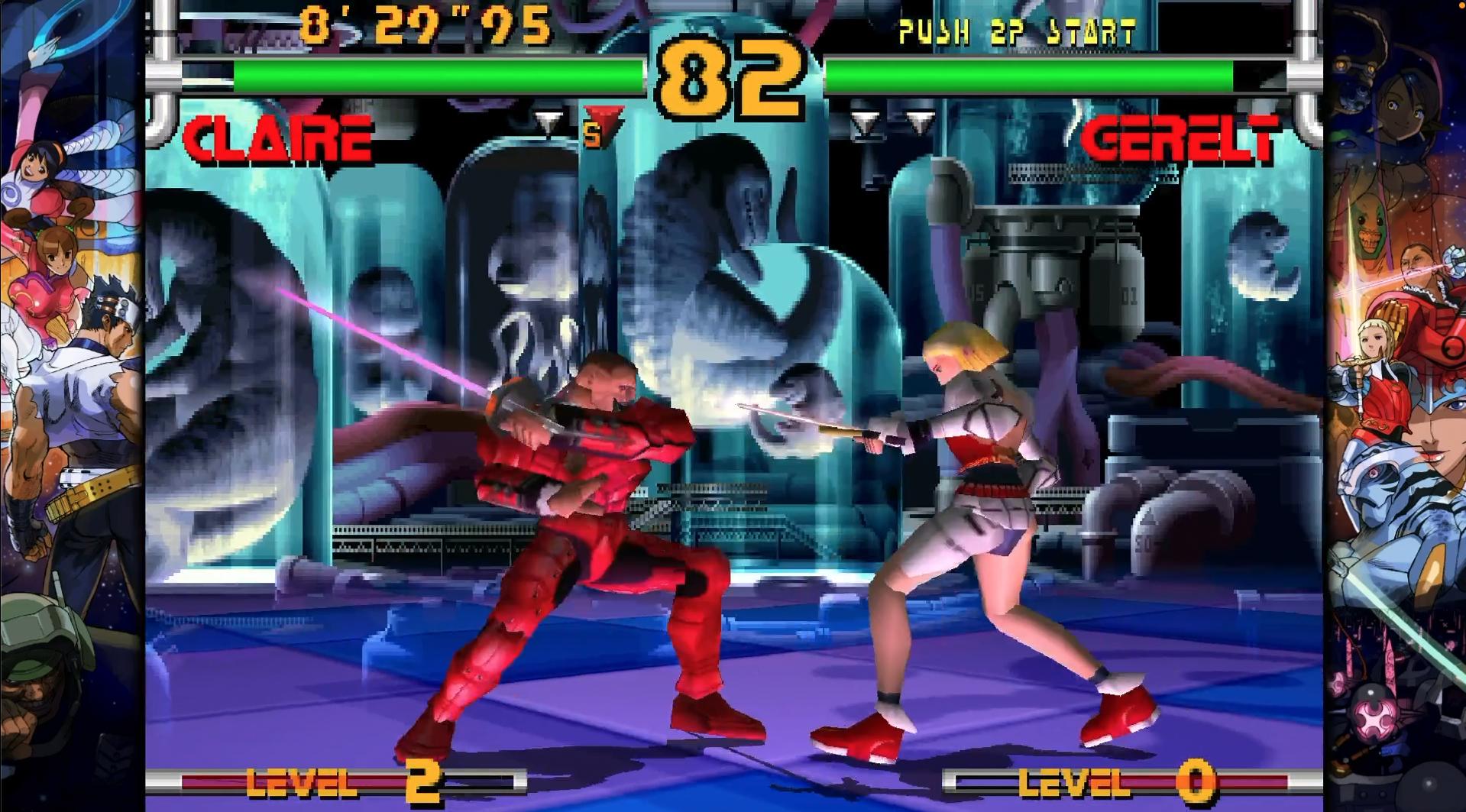
I recently picked up Capcom Fighting Collection 2 for the Nintendo Switch, and while the entire collection contains 8 games from Capcom's fighting back catalog I primarily picked this game up for two reasons, Power Stone and Power Stone 2. I have some pretty fond memories of these Dreamcast-era arena fighters and getting the opportunity to play the arcade ports on the go has scratched the decades long itch I have had to return to these games. However, to my surprise, the majority of time spent playing this collection has not been with Power Stone. Instead I have spent most of my time digging into this obscure 3D fighter tucked away on this collection called Plasma Sword: Nightmare of Bilstein.
Plasma Sword takes place hundreds of years in the future on a planet called Zeta, and the main villain is Dr. Bilstein, a maniacal terrorist hellbent on destroying the galaxy. This game is a direct sequel to an earlier Capcom 3D fighter called Star Gladiator. The futuristic setting lays the groundwork for cool character designs and sci-fi effects that give the game a certain charm that can really draw you in.
So why am I so captivated by this game? First and foremost this setting makes Plasma Sword feel special. To my knowledge, we just do not get many fighting games in a space-opera sci-fi setting. The characters lean into weirdness hard, and the plasma abilities are flashy and satisfying without being overly difficult to execute.
The combat is smooth and responsive, centering around plasma abilities you can use offensively and defensively. The real star is the Plasma Field mechanic, where you trap your opponent in a different dimension and temporarily shift the entire fight dynamic. It is trippy, dramatic, and always exciting to pull off.
This game also made me reflect on fighting games as a genre. Over time, modern competitive pressure can make these games feel less approachable for casual play. But Plasma Sword reminded me how fun fighting games can be when you ignore meta anxiety, play at your own pace, and enjoy the process of learning characters and systems.
I also keep thinking about why this game got overlooked. It launched in a crowded era with technically stronger headline fighters. But revisiting older games today can reveal things critics and players missed at launch. Plasma Sword may have been overshadowed then, but it absolutely has its own identity and charm now.